in doing narrative research, you will:
purposefully select your participant -connected to the research inquiry- willing to tell stories of personal experiences that are worth to be reported concerning your educational inquiry- remember that this type of research is in collaboration with the participant, due to the sample size -write your final report, look for its validation (triangulation), and consider the possible ethical issues. You will also have to keep in mind the theoretical lens being used (Creswell, 2012, p. 505).
Creswell (2012) proposes seven major charactristics in doing narrative research:
– Individual experiences
– Chronology of the experiences
– Collecting individual stories
– Restorying
– Coding for themes
– Context or setting
– Collaborating with participants
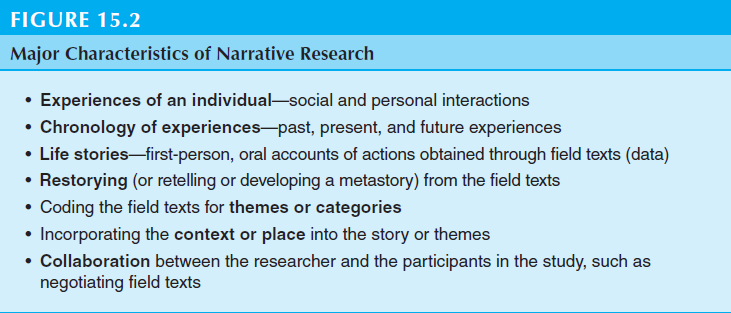
Individual experiences: from the philosophy of John Dewey (p. 507).
Chronology of the experiences: ”For example, in a study about a teacher’s use of computer technology in a high school classroom, the inquirer would include information about the teacher’s introduction to computers, current computer use, and future goals and aspirations” (p. 508).
Collecting individual stories: ”Narrative researchers place emphasis on collecting the stories told to them by individuals or gathered from a wide variety of field texts.(…) In a more general sense, the story might include the elements typically found in novels, such as time, place, plot, and scene” (Connelly & Clandinin, 1990, in Creswell, 2012, p. 508).
Restorying: ”Restorying is the process in which the researcher gathers stories, analyzes them for key elements of the story (e.g., time, place, plot, and scene), and then rewrites the story to place it in a chronological sequence” (p. 509).
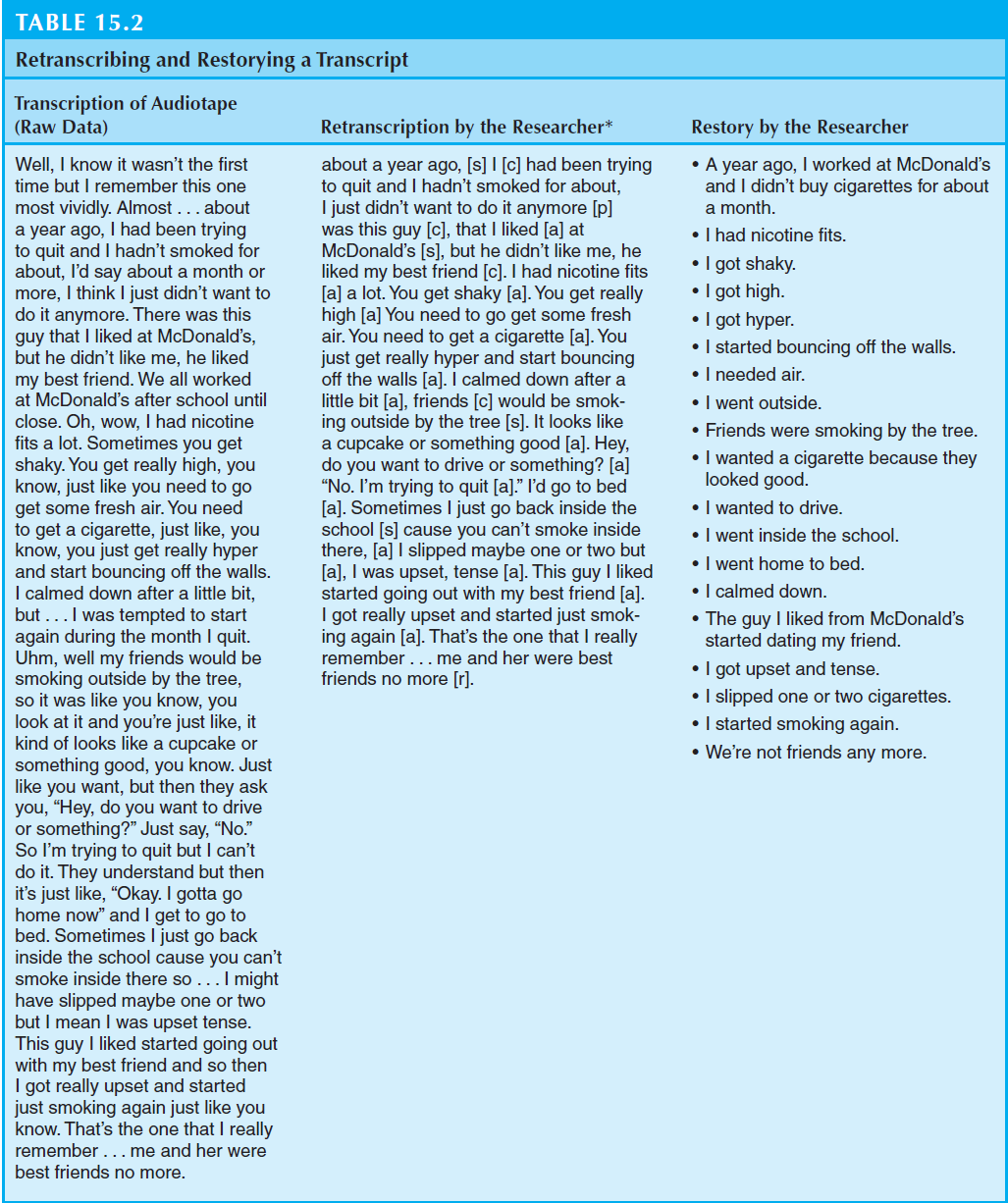
You can also write the story elements in a way of problem solution as presented in p. 511 of the textbook:

The table below is a narrative structure containing three dimensions such as interaction, continuity, and situation:

Coding for themes: ”As with all qualitative research, the researcher identifies a small number of themes, such as five to seven. Researchers incorporate these themes into the passages about the individual’s story or include them as a separate section in a study. Narrative researchers typically present these themes after retelling the story” (p. 511).
Context or setting: ”Narrative researchers describe in detail the setting or context in which the individual experiences the central phenomenon. In the restorying of the participant’s story and the telling of the themes, the narrative researcher includes rich detail about the setting or context of the participant’s experiences” (p. 512).
Collaboration: ”Collaboration often calls for a good working relationship between teachers and researchers, an idealized situation that takes time to develop as a mutually illuminating story between the researcher and the teacher” (Elbaz-Luwisch, 1997, in Creswell, 2012, p. 512).
what about the ethical issues?
Like in any research designs, ethical issues may and do arise. It is an important point to cite when presenting the final project. The textbook explains clearly and states how to handle it:
Participants may not be able to tell the real story. This inability may arise when
experiences are simply too horrific to report or too raw to recall (e.g., Holocaust victims, disaster victims). It may also occur when individuals fear sanctions against them if they report their story, such as in sexual harassment cases. The real story may also not emerge because individuals simply cannot recall it—the story is buried too deeply in the subconscious. It may also occur because individuals base their stories on events that happened years ago, leading to early memories that may distort events and provide inventions of past actions (Lieblich et al., 1998).
Although distortion, fear of reprisal, and inability to tell may plague storytellers, narrative researchers remind us that stories are “truths of our experiences” ( Riessman, 1993 , p. 22) and that any story told has an element of truth in it.
(Creswell, 2012, p. 512)
 narrative research design