Several examples of narrative research are presented in the textbook (Creswell, 2012, p. 504) such as:
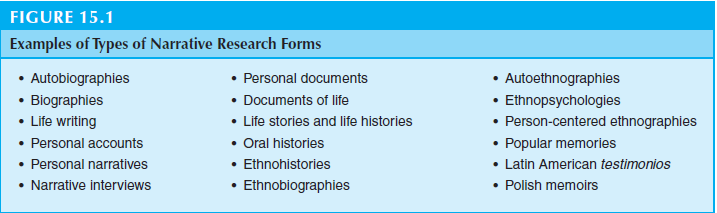
who writes?
In a biography, for example, it is the researcher. But in an autobiography, the person recording and writing the stories is the subject being studied. In narrative research, there is a close collaboration between the participant and the researcher due to the very small sample being studied.
”In an autobiography, the individual who is the subject of the study writes the account. Although not a popular approach, you can find reports of autobiographical accounts of teachers as professionals” (Connelly & Clandinin, 1990, in Creswell, 2012, p. 504).
how?
Biography: records, archives, interviews, photographs, etc.
Autobiography: the researcher is also reflecting on his or her story and links it with those of others.
Field texts and data: discussion, group conversation, one-on-one interviews, family stories, photographs, memory boxes, journals, letters, ”these letters may be written back and forth between participants, between research collaborators, or between the researchers and participants” (Clandinin & Connelly, 2000, in Creswell, 2012, p. 508).
whose stories?
Can be many people within the education system, for example: administrators, school board members, custodians, food service workers, and other educational personnel.
Teacher: ”report teachers’ stories to capture the lives of teachers as professionals and to examine learning in classrooms” (e.g., Connelly & Clandinin, 1988, in Creswell, 2012, p. 504).
Student: ”narrative researchers ask the children in classrooms to present orally or in writing their own stories about their learning experiences” (e.g., Ollerenshaw, 1998, in Creswell, 2012, p. 504).
 narrative research design